
Since 1 November 2021, Article 913, paragraph 3, of the French Civil Code allows a child to claim a compensatory levy (prélèvement compensatoire) on assets located in France at death. The levy is available where the deceased or at least one child is a national of, or habitually resident in, an EU Member State, and where the foreign law governing the succession “provides no reserved-share mechanism protecting children”. The rule was challenged before the European Commission as conflicting with the freedom to choose the law of one’s nationality under EU Succession Regulation 650/2012 (Art. 22).
France’s answer to the Commission
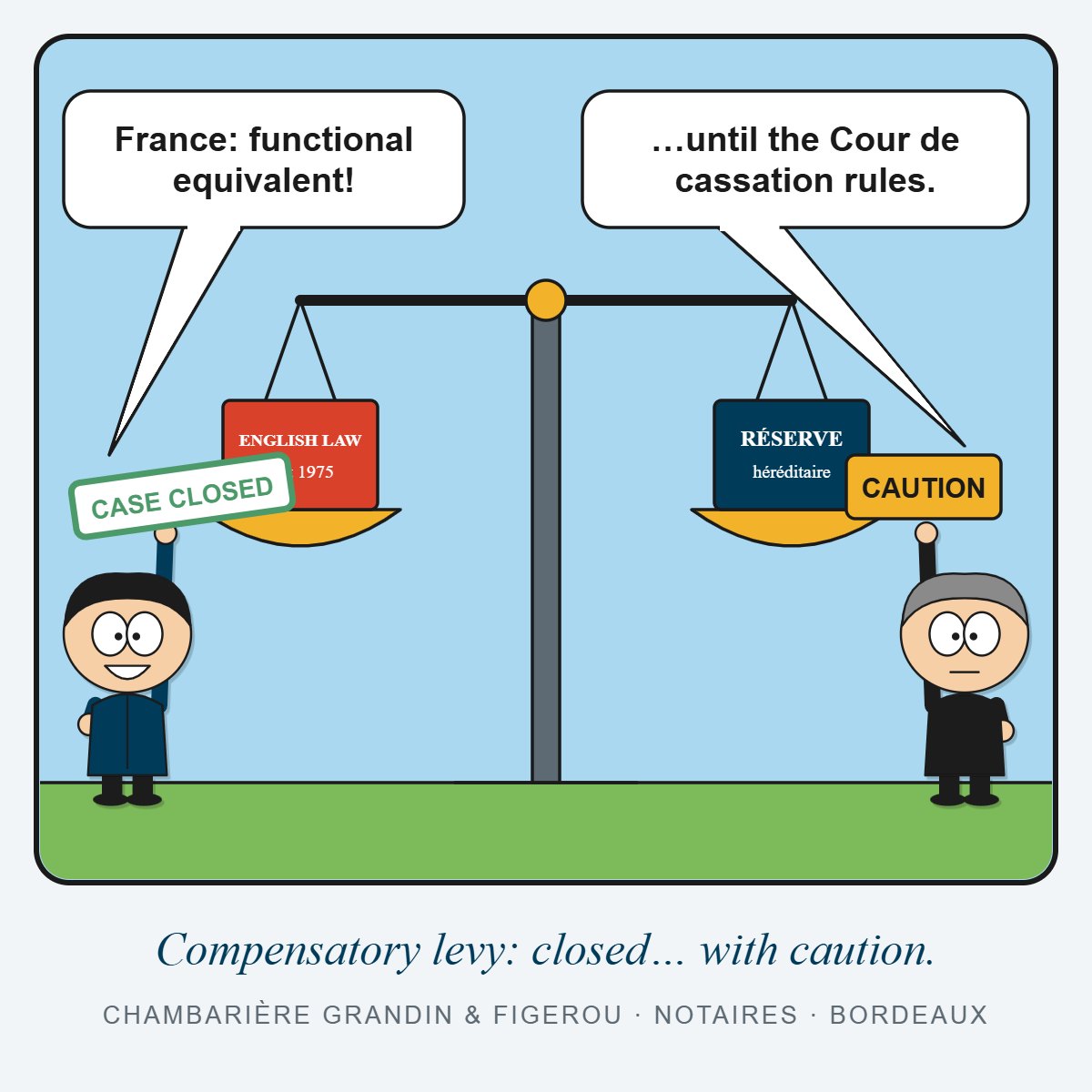
In a pre-closure letter dated 1 June 2026, the Commission considers the legal uncertainty resolved, on the basis of the explanations provided by the French authorities. In its answer to the Commission, France stated that the provision must be read literally and restrictively and does not impose French forced heirship. France also stated that family provision under English law (Inheritance (Provision for Family and Dependants) Act 1975) is a functional equivalent of the réserve héréditaire, so that a French court should not apply the levy where English law governs the succession. This is the French government’s position, accepted by the Commission; it is not a court ruling.
What does not change
Forced heirship remains fully applicable to successions governed by French law. Without a valid choice of law in a will, the law of habitual residence applies (Art. 21 of the Regulation): a British national habitually resident in France therefore remains subject to French law. The Commission’s letter does not bind French courts, and the Cour de cassation has not ruled on this equivalence.
Rule of caution
Until the Cour de cassation has ruled, the risk of a levy should be treated as reduced, not eliminated. It increases with the value of the assets held in France. No will should be amended, and no asset sold or restructured, on the strength of this development alone. Any choice of law should be made expressly in a will and checked against your habitual residence, your family situation and the location of your assets. Ask the office to review your documents before taking any step.
Source: European Commission, multiple complaint CPLT (2022) 03325, pre-closure letter of 1 June 2026; French Civil Code, art. 913, para. 3 (Act no. 2021-1109 of 24 August 2021). This note is general information and does not constitute legal advice.